


I’ve been quiet for a few months. Not because I ran out of things to say (if you know me at all, you know that’s not the problem). I’ve been quiet because winter in San Francisco is when Hetch Hetchy shuts down for maintenance, and when Hetch Hetchy shuts down, everyone at SF Water gets very, very busy. It’s our Super Bowl season, except instead of halftime shows we get emergency valve replacements at 2 AM.
I have a folder full of half-written articles. Writing helps me think, so they exist whether they’re any good or not. But between covering shifts and managing winter flows, finishing them felt like trying to complete a thought while someone’s shouting at you about a chlorine alarm.
So instead of writing, I built something.
The Babysitting Gig
You ever see Adventures in Babysitting? Elizabeth Shue takes what should be a simple gig - watch some kids for a night - and ends up on a wild ride across Chicago involving car thieves, blues clubs, and situations she absolutely did not sign up for.
That’s been my career arc, basically.
I took what should have been a straightforward job, water treatment operator, somehow ended up here: writing essays about regulatory frameworks, building process simulators, thinking about AI and workforce development, connecting with industry associations, and reading white papers at night because... I don’t know why lol.
At some point in the chaos, you have a choice: cut your losses and run, or knuckle down and address the challenges in front of you.
Don’t mess with the babysitter.
I knuckled down. And now my Google Drive is completely full.
The “Drive is Full” Problem
Here’s the mundane reality: I have research, process diagrams, calculators I’ve built, technical notes, tools I’ve made for myself, and ideas that help me process the job. All of it is scattered across folders and local directories, and I’m running out of space.
Substack is great for essays, but you can’t really host files there. I can’t upload a chlorine dose calculator or share a flocculation basin simulator through a Substack article. I needed somewhere to put the stuff.
More importantly, I realized something about how we should be thinking about sharing tools in 2026. We don’t need one perfect calculator that works for everyone. We need to share the concept of the calculator, then let AI help each person customize it for their specific plant. Your clarifier dimensions are different from mine. Your chemical feed setup is different. Your source water chemistry is different.
So when I share a simulator, I’m not saying “use this exact model.” I’m saying “here’s how I approached the problem, now ask Claude or ChatGPT to adjust it for your facility.” The sharing gives us the starting point. The AI tools let us make it perfect for our use case.
I’d love to see what other people are building. Maybe there’s a forum or community space for that down the line. But that’s a different project. This one is simpler: I’m basically just making my drive public.
Unpacking the Archive
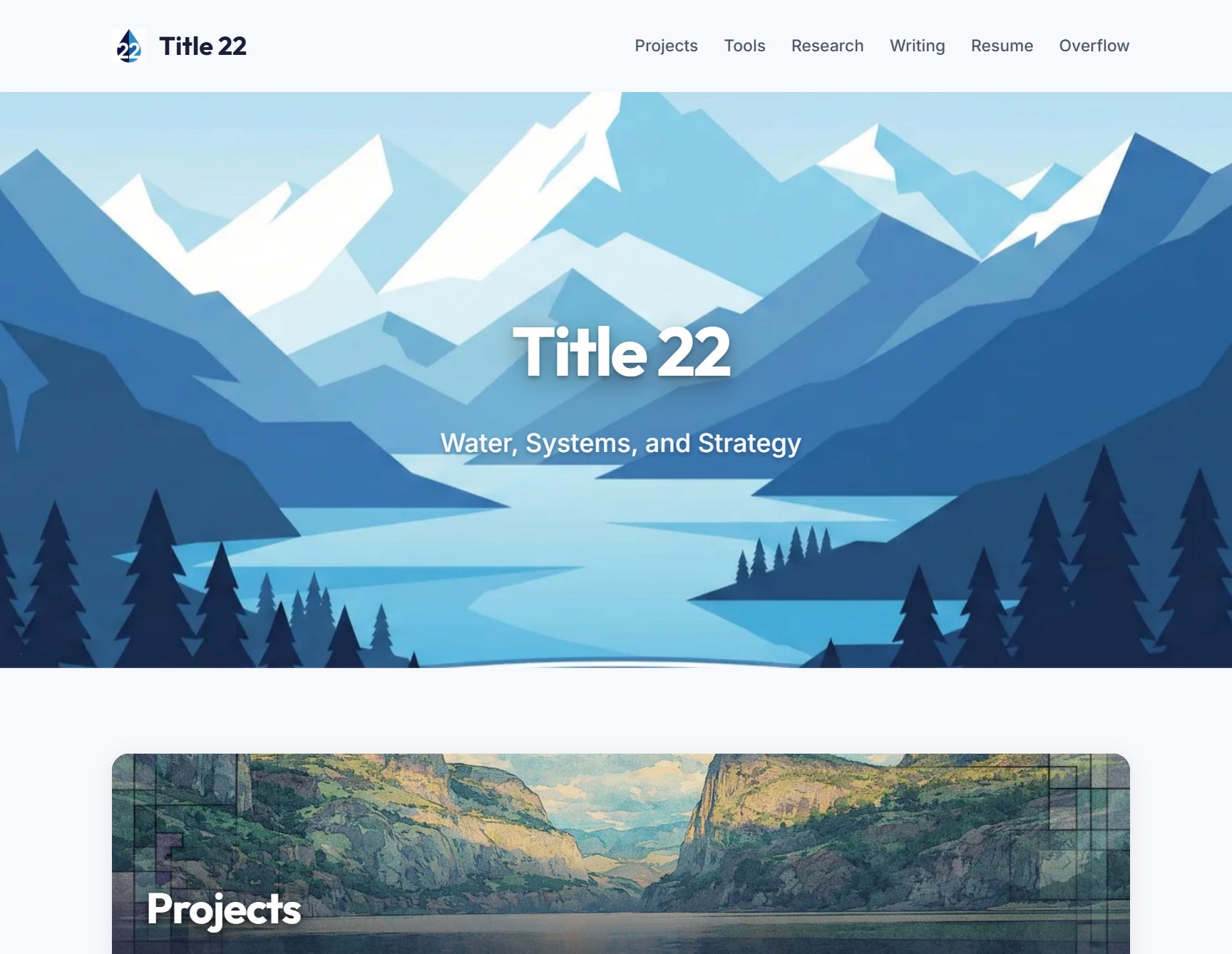
The site has five sections:
Projects: The big builds. Simulators, process models, and writeups of problems I’ve worked through.
Tools: Calculators, checklists, and templates I’ve made for myself. You can download them and customize them with AI for your facility.
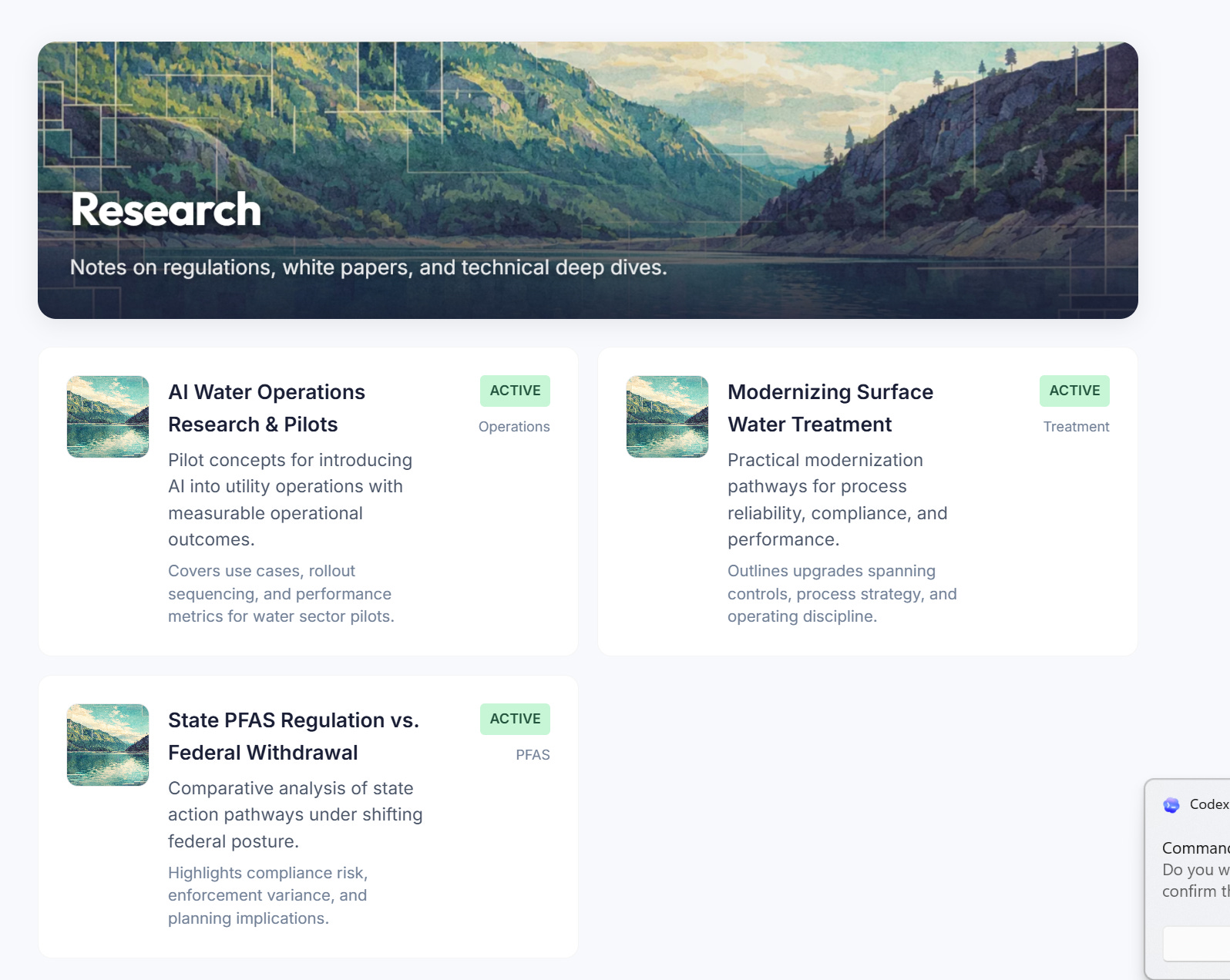
Research: Deep dives into regulations, white papers, and technical notes. The stuff I read when I’m trying to understand something.
Writing: The literary side. Essays that use water as a lens to understand bigger patterns.
Resume: Because this is also a professional site and sometimes you need to show the receipts.
It’s Version 1.0. Some sections are thin. But it exists, it’s public, and it’s useful now rather than perfect later.
Flipping the “Private” Switch
Look, I’m being honest: this is primarily storage for me. I need somewhere to put work that I see in browser. Making it public is basically just removing the “private” flag, and might as well let people see what I’m building.
But there’s value in working in public. When I write about data-driven operations, I can now link to a tool that demonstrates the concept. Theory and practice, same place. And if someone else finds it useful, great. If they take the concept and have AI rebuild it for their context, even better.
Your plant is different from mine. You shouldn’t use my tools directly, you should use them as a starting point for building yours.
Back to the Control Room
Hetch Hetchy shut down season is wound down early, which means I have time to write again. Those half-written articles are getting some attention. I don’t know if they’re good, but they help me think. Now, when I reference a concept, I can also link to a tool that demonstrates it.
When I build something, I have a place to put it where it won’t disappear when I switch computers or my drive fills up.
The site is live at projects.title22.org. It will also be in the header on my substack. Go poke around if you’re curious. Use what helps you. Ignore the rest.
And remember: nobody leaves this industry without “singing the blues” a little bit. You can either run away from the chaos, or you figure out how to deal with it and maybe even enjoy the ride.
See you in the next one.